
When Christians should change churches after conflict
Discover what path to take depending on conflicts
Bobby Frost
5/9/20265 min read
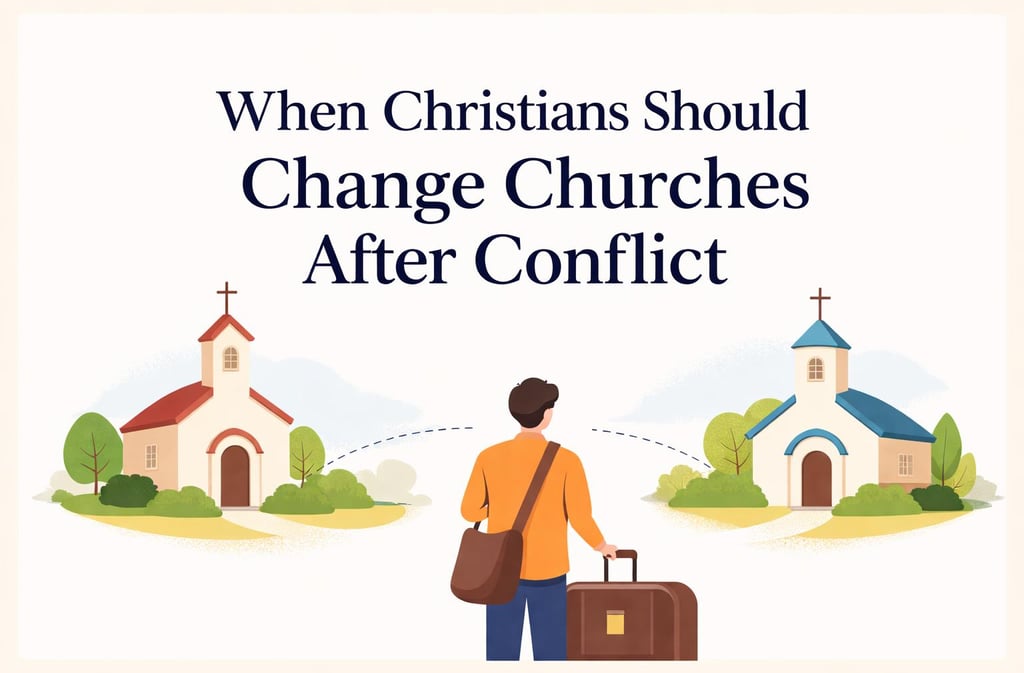
Change churches after conflict? Sometimes, yes. Sometimes, absolutely not. And honestly, the hardest part is that both choices can feel spiritual. You can stay and call it faithfulness. Or you can leave and call it wisdom. So I’m going to get practical about the difference.
Not every conflict means it is time to leave
Look, church is family. And family gets weird. People misunderstand each other. Someone talks too fast in a hallway. Someone else fills in the blanks with fear. Boom. Now it’s “a thing.”
I used to think conflict automatically meant the church was unhealthy. Turns out, conflict is also just what happens when humans try to follow Jesus together. The question isn’t “Did conflict happen?” It’s “What happened next?”
Normal conflict has a repentance trail
In my experience, healthy conflict leaves breadcrumbs of humility. Not perfection. Just movement.
Matthew
Someone says, “I’m sorry.” Someone else says, “I can see how I hurt you.” Leadership doesn’t get defensive when you ask clarifying questions. There’s a Matthew 18 vibe. Not a PR vibe.
Unhealthy conflict gets managed, not healed
Here’s the thing. Some churches are incredible at managing optics. They can keep things quiet. They can keep things “nice.”
But they can’t keep things honest.
And if every hard conversation gets rerouted into vagueness. Or you get labeled “divisive” for asking basic questions. That’s not just conflict. That’s a system protecting itself.
When I’m sorting this out with someone, I’ll often point them back to identity first. Not because it fixes everything. But because church conflict loves to mess with your sense of belonging. If you want that bigger foundation, I wrote a main guide on identity in Christ and the obstacles that mess with it that pairs well with this exact situation.
Signs the environment is spiritually unsafe
Real talk: “unsafe” gets thrown around. Sometimes it’s legit. Sometimes it’s just “I’m uncomfortable.” Those aren’t the same. Discomfort can be discipleship. Unsafety is different. It shrinks your soul.
Control and fear are doing the real work
Most people can feel it, even when they can’t name it. You start monitoring your tone. You rehearse sentences before you speak. You avoid certain people like they’re landmines.
And the church language gets weaponized. “Submission” means “don’t question.” “Unity” means “don’t talk.” “Honor” means “don’t tell the truth about harm.” That stuff isn’t new. It’s just dressed up.
Accountability only goes one direction
I had a client who tried to address a clear miscommunication with a leader. Calm tone. Specific examples. No theatrics. The response? A meeting with three leaders and a “concern about her heart.”
That’s the move. Shift from behavior to character. From facts to fog.
If you can’t ask for clarification without getting spiritually diagnosed, you’re not in a normal disagreement anymore. You’re in a power problem.
You’re pressured to forgive fast, but nobody talks about repair
Questions are treated like threats
Leaders close ranks and refuse outside input
Patterns repeat, and the same people keep getting hurt
Confidential details get shared to “manage” you
And yes, I know. Leaving can feel like failure. Especially when you’ve been taught that loyalty equals holiness. That teaching can wound you for years.
When staying is actually enabling
Thing is, some of us stay because we’re trying to be “the mature one.” I get it. I’ve done it. I called it peacemaking. It was mostly fear.
Staying can be faithful. But staying can also become a way to keep the machine running while your heart quietly dries out.
You keep doing all the reconciling
Here’s what I mean. You apologize. You ask questions gently. You offer coffee. You try again. You write the careful text. You reframe it more kindly. Again.
And the other side? No ownership. No curiosity. Just silence. Or spiritual platitudes. Or a little smirk of “we’ll pray for you.”
That imbalance matters. Reconciliation is a two-person sport. And repentance is not a vibe. It’s actions.
Your conscience is getting trained to ignore red flags
This bugs me. When Christians stay in unhealthy settings long enough, they start calling their discernment “a critical spirit.” They start distrusting their own nervous system.
But your body often tells the truth before your theology catches up. Tight chest on Sunday mornings. Dread when your phone buzzes. Relief when you’re out of town. That isn’t definitive proof. Still, it’s data.
If this whole topic is tangled up with old church wounds, you’re not alone. I’ve watched that history shape decisions more than people realize. The broader theme shows up a lot on my resources on identity in Christ and church wounds, especially for believers trying to rebuild trust without losing wisdom.
A framework I use to decide whether to go
So, how do I personally sort it out? Not with one question. With a few. And I try to answer them slowly. Over weeks, not hours.
Can this church handle the truth?
I don’t mean, “Do they preach the Bible?” Lots of churches do. I mean, “Can they handle reality about themselves?”
When you bring a concern, do they get curious or threatened? Do they ask follow-up questions? Do they reflect? Or do they instantly defend and redirect?
A church that can’t tolerate truth will eventually punish whoever carries it.
Is there a path for repair that does not require you to shrink?
Some repair paths are fake. They sound godly, but they require you to disappear.
Like: “Just forgive and move on, and don’t bring it up again.” Or: “We’ll meet, but only if you promise you’re not upset.” Or the classic: “Let’s not talk about specifics.”
I recommend looking for a repair path that includes specifics, ownership, and time. Not endless meetings. Not performative apologies. Actual repair.
And ask yourself a blunt question. After every conversation, do you feel more clear? Or more confused? Confusion that keeps multiplying is usually a sign the process is being managed, not healed.
How to leave with integrity and without torching your faith
Honestly? Leaving can be righteous. It can also get messy fast. I’ve watched people leave like they’re escaping a burning building. Sometimes that’s accurate. But sometimes the fire is mostly inside their nervous system, and they carry it into the next church.
I want better for you than that.
Don’t make your next church pay for your last one
When I started doing pastoral care work years ago, I didn’t see this pattern at first. Now I see it all the time.
Someone leaves after a painful conflict. They promise themselves they’ll “never get hurt again.” So they stay on the edges. They don’t join a group. They don’t let anyone know them. Then they say the new church feels “shallow.”
It might not be shallow. You might just be armored.
Leave clearly, not theatrically
Sometimes you need to leave quietly for safety. I’m not here to shame that. But if you can leave clearly, it usually helps your soul.
A short note. A direct conversation. No scorched-earth email. No vague social media posts. No recruiting people to your side. I’ve never seen that bring peace. Not once.
And one more thing. Don’t demand an apology as your exit ticket. I know that sounds harsh. But I’ve watched people tie their healing to someone else’s confession. That’s a long wait.
You can leave because you’re called to truth. Because you want to worship without bracing for impact. Because you’re tired of being cast as the problem for telling the truth. That’s enough.
FAQs for When Christians should change churches after conflict
Is changing churches after conflict a sin?
Usually, no. It can be sinful depending on motive and behavior. Like leaving to avoid repentance, or leaving to punish people, or leaving while spreading accusations you can’t support. But leaving because leadership refuses repair, because there’s ongoing manipulation, or because your family is being harmed spiritually? In my experience, that’s often wisdom, not rebellion.
How long should I try to work it out before I leave?
I don’t have a magic number. I watch for movement. Are conversations producing clarity, confession, and change? Or are they producing fog, blame-shifting, and pressure to be quiet? If you’ve made honest attempts, involved appropriate leadership, and the pattern stays the same, I usually see people get freer when they stop waiting for the place to become something it’s not.
Prophetic Transformation
Contact
Newsletter
bob@bobbyfrost.com
© 2026.All rights reserved.